
Introduction
Verbs and tenses are the foundation of English grammar. Every sentence we speak or write depends on them to express actions and time clearly. Without proper use of verbs and tenses, communication can become confusing and unclear. Understanding these two elements helps learners form correct sentences and express ideas confidently.
What Are Verbs and Tenses in English Grammar?
In English grammar, a verb is a word that shows an action, a state of being, or an occurrence. It tells us what the subject of a sentence is doing or experiencing.
Examples: run, eat, is, are, write, think.
A tense, on the other hand, indicates the time at which an action happens. It tells us whether something happens in the present, past, or future. Tenses work together with verbs to show when an action takes place.
Example:
- She writes (present)
- She wrote (past)
- She will write (future)
Why Learning Verbs and Tenses Is Important
Learning verbs and tenses is essential for using English accurately and fluently. They help you:
- Express actions and events clearly
- Communicate time correctly in sentences
- Avoid grammatical mistakes in writing and speaking
- Improve reading, listening, and exam performance
Whether you are a student, a beginner, or someone improving English skills, mastering verbs and tenses makes your communication more natural and effective.
What Are Verbs?
A verb is one of the most important parts of a sentence. It tells us what the subject does, what happens, or what state the subject is in. Without a verb, a sentence cannot be complete or meaningful.
Definition of Verbs
In English grammar, a verb is a word that expresses:
- an action (what someone or something does),
- a state of being (what someone or something is),
- or an event or occurrence.
Examples:
- She runs every morning.
- He is a teacher.
- The baby slept peacefully.
In all these sentences, the verb gives life to the sentence by explaining the action or condition.
Examples of Verbs in Sentences
Here are some simple examples to understand verbs better:
- I eat breakfast daily.
- They play cricket after school.
- She is happy today.
- We were studying last night.
- He will complete the work tomorrow.
Each sentence contains a verb that shows either an action or a state, and it also helps identify the tense of the sentence.
Role of Verbs in English Grammar
Verbs play a key role in grammar because:
- They decide the tense of a sentence
- They show time, action, and condition
- They connect the subject with the rest of the sentence
Without verbs, ideas cannot be clearly expressed in English.
Types of Verbs in English Grammar
Verbs can be divided into different types based on their function in a sentence. Understanding these types helps you use verbs and tenses correctly and form accurate sentences.
Action Verbs
Action verbs show physical or mental actions. They tell us what the subject is doing.
Examples:
- She writes a letter.
- They play football.
- He thinks carefully.
Action verbs are the most commonly used verbs in English.
Linking Verbs
Linking verbs do not show action. They connect the subject to more information about the subject.
Common linking verbs include: is, am, are, was, were, seem, become, feel
Examples:
- She is tired.
- The sky looks clear.
- He became a doctor.
Helping (Auxiliary) Verbs
Helping verbs assist the main verb to form different tenses, questions, and negatives.
Common helping verbs: is, am, are, was, were, has, have, had, will, shall
Examples:
- She is reading a book.
- They have finished the work.
- He will go tomorrow.
Modal Verbs
Modal verbs express ability, possibility, permission, advice, or obligation.
Common modal verbs: can, could, may, might, must, should, would
Examples:
- You should study regularly.
- She can swim well.
- We must follow the rules.
Transitive and Intransitive Verbs
- Transitive verbs need an object.
Example: She bought a dress. - Intransitive verbs do not need an object.
Example: The baby cried.
Understanding these types of verbs will make learning tenses much easier and improve your overall grammar.
difination to Verbs and Tenses
What Are Verbs and Tenses in English Grammar?
In English grammar, verbs are action words that describe what someone or something does, feels, or is. They are the heart of every sentence because they express action, occurrence, or a state of being. Examples include run, eat, think, be, have, and feel.
Tenses, on the other hand, indicate the time of an action or state. They help the reader or listener understand whether something happened in the past, is happening in the present, or will happen in the future. Using the correct tense ensures clarity and precision in communication.
For example:
- Present tense: She runs every morning.
- Past tense: She ran yesterday.
- Future tense: She will run tomorrow.
Why Learning Verbs and Tenses Is Important
Understanding verbs and tenses is crucial for effective communication. Here’s why:
- Clear Communication: Correct use of verbs and tenses ensures that your sentences convey the right time and meaning.
- Improved Writing Skills: Accurate tenses make your writing logical, professional, and easy to understand.
- Better Speaking Skills: Speaking with proper verb forms and tenses makes conversations smooth and understandable.
- Avoid Confusion: Misusing tenses can confuse readers or listeners about when an action happened or will happen.
In short, verbs and tenses are the backbone of English grammar. Mastering them helps you speak, write, and understand English confidently.
Main Types of Tenses in English
Understanding tenses is key to expressing actions correctly in English. The three main types of tenses are Present, Past, and Future. Let’s take a closer look at each.
Present Tense Overview
The present tense is used to describe actions happening now, general truths, or habitual actions.
- Example (Simple Present): She reads every morning.
- Example (Present Continuous): She is reading a book right now.
- Example (Present Perfect): She has read three books this month.
Past Tense Overview
The past tense describes actions that have already happened or were completed in the past.
- Example (Simple Past): He played football yesterday.
- Example (Past Continuous): He was playing football when it started raining.
- Example (Past Perfect): He had played football before his friend arrived.
Future Tense Overview
The future tense is used to talk about actions that will happen later.
- Example (Simple Future): They will travel to Paris next week.
- Example (Future Continuous): They will be traveling when you arrive.
- Example (Future Perfect): They will have traveled to five countries by December.
Present Tense Explained
The present tense is used to describe actions happening now, habitual actions, or general truths. In English, there are four main types of present tense:
Simple Present Tense
The simple present tense expresses regular actions, habits, or universal truths.
- Structure: Subject + base verb (add -s or -es for third person singular)
- Examples:
- She reads books every day.
- The sun rises in the east.
Present Continuous Tense
The present continuous tense describes actions happening right now or temporary situations.
- Structure: Subject + am/is/are + verb + -ing
- Examples:
- He is studying for his exams at the moment.
- They are playing football in the park.
Present Perfect Tense
The present perfect tense connects past actions with the present, showing that the action is relevant now.
- Structure: Subject + has/have + past participle
- Examples:
- She has visited London three times.
- I have finished my homework.
Present Perfect Continuous Tense
The present perfect continuous tense emphasizes the duration of an action that started in the past and continues into the present.
- Structure: Subject + has/have been + verb + -ing
- Examples:
- He has been working here for five years.
- They have been studying since morning.
Past Tense Explained
The past tense is used to describe actions or events that happened and were completed in the past. There are four main types of past tense in English:
Simple Past Tense
The simple past tense expresses actions that occurred at a specific time in the past.
- Structure: Subject + past form of the verb
- Examples:
- She visited Paris last year.
- They watched a movie yesterday.
Past Continuous Tense
The past continuous tense describes actions that were ongoing at a specific moment in the past.
- Structure: Subject + was/were + verb + -ing
- Examples:
- He was reading a book when I called him.
- They were playing football all afternoon.
Past Perfect Tense
The past perfect tense shows that an action was completed before another action in the past.
- Structure: Subject + had + past participle
- Examples:
- She had finished her homework before her friends arrived.
- I had eaten dinner when he called.
Past Perfect Continuous Tense
The past perfect continuous tense emphasizes the duration of an action that was ongoing in the past before another past action.
- Structure: Subject + had been + verb + -ing
- Examples:
- He had been working at the company for ten years before he retired.
- They had been studying all night before the exam.
Future Tense Explained
The future tense is used to describe actions or events that will happen later. There are four main types of future tense in English:
Simple Future Tense
The simple future tense expresses actions that will happen in the future.
- Structure: Subject + will/shall + base verb
- Examples:
- She will travel to Japan next year.
- They will attend the meeting tomorrow.
Future Continuous Tense
The future continuous tense describes actions that will be ongoing at a specific time in the future.
- Structure: Subject + will be + verb + -ing
- Examples:
- He will be studying at 8 PM tonight.
- They will be playing football when you arrive.
Future Perfect Tense
The future perfect tense shows that an action will be completed before a specific time in the future.
- Structure: Subject + will have + past participle
- Examples:
- She will have finished her project by Monday.
- I will have read the book before the class.
Future Perfect Continuous Tense
The future perfect continuous tense emphasizes the duration of an action that will be ongoing up to a certain point in the future.
- Structure: Subject + will have been + verb + -ing
- Examples:
- He will have been working here for five years by next month.
- They will have been traveling for ten hours by the time they reach the city.
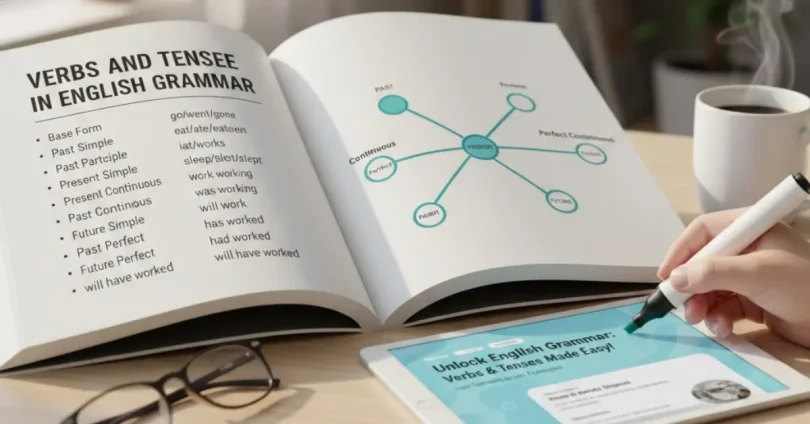
Verb Forms and Their Role in Tenses
Verbs in English have different forms, and each form plays a crucial role in creating the correct tense. Understanding these forms is essential for constructing proper sentences.
Base Form of Verb
The base form is the original form of a verb without any endings. It is used in the simple present tense (except for third person singular) and with modal verbs.
- Examples: go, eat, play, read, write
- Usage:
- I play football every Sunday.
- She can read French.
Past Form of Verb
The past form expresses actions that happened in the past. Regular verbs add -ed to the base form, while irregular verbs have unique past forms.
Examples:
- Regular: play → played, watch → watched
- Irregular: go → went, eat → ate
Usage:
- He went to the market yesterday.
- They watched a movie last night.
Past Participle Form
The past participle is used in perfect tenses and the passive voice. Regular verbs usually add -ed, while irregular verbs have unique forms.
Examples:
- Regular: played, watched, cleaned
- Irregular: gone, eaten, written
Usage:
- She has eaten lunch already.
- The book was written by a famous author.
Present Participle (-ing Form)
The present participle ends in -ing and is used in continuous tenses.
- Examples: playing, eating, writing, reading
- Usage:
- He is playing football now.
- They were reading books when I called.
Subject–Verb Agreement in Tenses
Subject–verb agreement is a fundamental rule in English grammar. It ensures that the verb matches the subject in number (singular or plural) and person. Using the correct form of the verb is essential for clear and grammatically correct sentences.
Singular and Plural Verb Rules
- Singular subjects take singular verbs.
- Example: She runs every morning.
- Example: The dog barks loudly.
- Plural subjects take plural verbs.
- Example: They run every morning.
- Example: The dogs bark loudly.
- With the present tense, add -s or -es for third person singular subjects.
- Example: He plays cricket.
- Example: She watches TV daily.
Common Agreement Mistakes
- Mistake 1: Using a plural verb with a singular subject.
- Incorrect: She go to school every day.
- Correct: She goes to school every day.
- Mistake 2: Using a singular verb with a plural subject.
- Incorrect: They was happy yesterday.
- Correct: They were happy yesterday.
- Mistake 3: Confusion with collective nouns (team, family, group).
- Example: The team is winning. (singular sense)
- Example: The team are arguing among themselves. (plural sense, individual members)
- Mistake 4: Ignoring intervening phrases between subject and verb.
- Incorrect: The bouquet of flowers are beautiful.
- Correct: The bouquet of flowers is beautiful.
By mastering subject–verb agreement, you can ensure your sentences are grammatically correct and clear in all tenses.
Common Errors in Verbs and Tenses
Even experienced English speakers often make mistakes with verbs and tenses. Being aware of these common errors can help improve both writing and speaking skills.
Mixing Tenses Incorrectly
Switching between tenses in a sentence or paragraph can confuse readers. Always maintain tense consistency unless showing a change in time.
- Incorrect: I was eating breakfast and then I go to school.
- Correct: I was eating breakfast and then I went to school.
Wrong Use of Helping Verbs
Helping verbs like is, are, was, were, has, have, will are essential in forming continuous and perfect tenses. Using them incorrectly leads to grammatical errors.
- Incorrect: She have gone to the market.
- Correct: She has gone to the market.
- Incorrect: They was playing football.
- Correct: They were playing football.
Incorrect Verb Forms
Using the wrong verb form can change the meaning of a sentence or make it grammatically wrong. Always match the verb form with the tense.
- Incorrect: He eat breakfast yesterday.
- Correct: He ate breakfast yesterday.
- Incorrect: I have saw that movie.
- Correct: I have seen that movie.
By avoiding these common mistakes, you can make your English writing and speaking more precise, professional, and easy to understand.
Tips to Master Verbs and Tenses Easily
Mastering verbs and tenses can seem challenging at first, but with consistent practice and smart strategies, anyone can improve quickly. Here are some practical tips:
Daily Practice Techniques
- Write sentences daily: Practice writing 5–10 sentences using different tenses every day.
- Keep a tense diary: Record what you did yesterday, what you are doing today, and your plans for tomorrow using correct tenses.
- Use online exercises: Many grammar websites and apps provide exercises for all verb forms and tenses.
Reading and Speaking Tips
- Read books, articles, and blogs: Notice how verbs and tenses are used in different contexts.
- Listen and speak: Pay attention to native speakers in movies, podcasts, or conversations, and try repeating sentences aloud.
- Practice speaking in all tenses: Describe your daily routine (present), yesterday’s events (past), and future plans (future).
How to Avoid Tense Confusion
- Identify time markers: Words like yesterday, now, tomorrow, already, yet help decide which tense to use.
- Stick to one tense per paragraph: Unless showing a change in time, avoid mixing tenses in the same paragraph.
- Review verb forms regularly: Memorize irregular verbs and practice using them in different tenses.
By following these Writing tips, you can gradually gain confidence in using verbs and tenses correctly in both writing and speaking.
Practice Section (Optional but Recommended)
Practice is the key to mastering verbs and tenses. This section provides exercises to help reinforce your understanding and improve your skills.
Fill in the Blanks
Complete the sentences using the correct verb form:
- She __ (go) to school every day.
- They __ (play) football when it started raining.
- I __ (finish) my homework already.
- By next week, he __ (complete) the project.
Identify the Tense
Read the sentences and identify which tense is used:
- She is reading a book right now.
- They went to the park yesterday.
- He will have finished the work by Monday.
- I have been studying for three hours.
Correct the Sentence
Spot the errors in verb usage and rewrite the sentences correctly:
- He go to the market yesterday.
- I have saw that movie before.
- They was playing football at 5 PM.
- She write letters every week.
Practicing these exercises regularly will strengthen your understanding of verbs and tenses and improve your grammar accuracy.
FAQs on Verbs and Tenses (SEO Booster)
What is the difference between a verb and a tense?
A verb shows an action, occurrence, or state of being (e.g., run, eat, be), while a tense tells when the action happens — past, present, or future.
How many tenses are there in English?
English has 12 tenses in total: 3 main tenses (Present, Past, Future) × 4 forms (Simple, Continuous, Perfect, Perfect Continuous).
Which tense is most commonly used in English?
The simple present tense is the most frequently used because it describes daily routines, habits, facts, and general truths.
Conclusion
Verbs are the action words that form the backbone of English sentences, while tenses show when an action happens — past, present, or future. Mastering the 12 tenses along with different verb forms like base, past, past participle, and present participle is essential for clear communication. By practicing daily, reading and listening to English content, and avoiding common mistakes, you can gradually gain confidence in using verbs and tenses correctly, making your writing and speaking accurate, professional, and easy to understand.