
Introduction
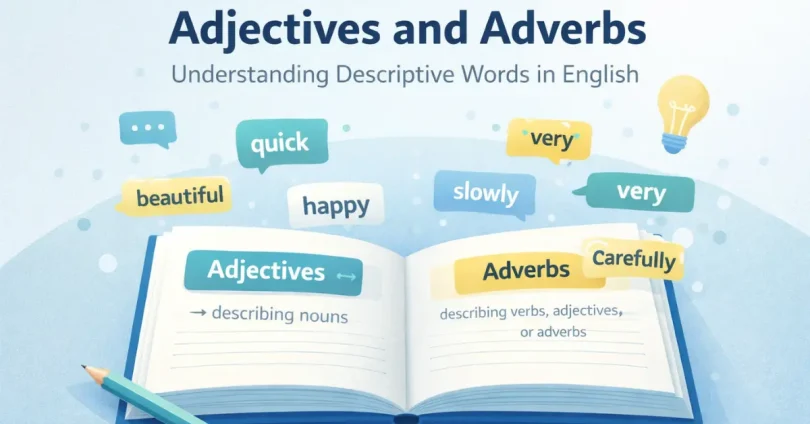
Understanding adjectives and adverbs is essential for anyone looking to improve their English. These two parts of speech play a crucial role in making your sentences more precise, descriptive, and engaging. While adjectives help you describe nouns—like a beautiful day or a tall building—adverbs give more information about verbs, adjectives, or other adverbs, such as She sings beautifully or He works very hard.
Many English learners struggle with these concepts. A common difficulty is confusing words like “hard” and “hardly”, which have very different meanings. Placement of adjectives and adverbs within a sentence is another challenge; even small mistakes can make sentences sound unnatural or confusing.
By reading this article, you will gain a clear understanding of:
- The difference between adjectives and adverbs
- Where to place them in a sentence for natural English
- Common mistakes and how to avoid them
- Advanced tips like strong adjectives and adjectives used as nouns
By the end of this guide, you will feel confident using adjectives and adverbs correctly, making your English speaking and writing more fluent, expressive, and professional.
Understanding Adjectives
An adjective is a word that describes or modifies a noun or pronoun. Simply put, adjectives give more information about a person, place, thing, or idea. They make your sentences more detailed and vivid, helping readers or listeners clearly understand what you mean.
Examples of Adjectives:
- The sunny day lifted everyone’s mood.
- She adopted a small puppy from the shelter.
- This is a difficult problem to solve.
- He is a talented musician.
In each of these examples, the adjectives (sunny, small, difficult, talented) describe a noun and give us a clearer picture of the subject.
Key Points About Adjectives:
Placement in a sentence:
- Before a noun: a beautiful garden
- After a linking verb (like is, seems, feels): The garden is beautiful
Types of adjectives:
- Quality: Describes what kind (beautiful, intelligent, strong)
- Quantity: Indicates how much or how many (few, many, several)
- Size: Shows size (big, tiny, huge)
- Color: Describes color (red, blue, green)
- Shape: Refers to shape (round, square, flat)
- Origin/Material/Purpose can also function as adjectives (Italian food, wooden table, running shoes)
Mini Exercise: Identify the Adjectives
Read the sentences below and underline the adjectives:
- The bright stars lit up the night sky.
- She bought a new laptop yesterday.
- He has a friendly dog that loves to play.
- They live in a spacious, modern apartment.
Answer: bright, new, friendly, spacious, modern
Understanding Adverbs
An adverb is a word that modifies a verb, an adjective, or another adverb. In simple terms, adverbs give more information about how, when, where, or to what extent something happens. They help make sentences clearer and more precise.
Common Questions Answered by Adverbs
- How? → Describes the manner in which an action is done.
- When? → Tells us the time of an action.
- Where? → Shows the location of an action.
- To what extent? → Indicates the degree or intensity of an action, adjective, or adverb.
Examples of Different Types of Adverbs
Adverbs of Manner (How?):
- She speaks clearly.
- He runs quickly.
Adverbs of Time (When?):
- I will call you tomorrow.
- She left yesterday.
Adverbs of Place (Where?):
- The children are playing outside.
- We met near the park.
Adverbs of Degree (To what extent?):
- She is very happy.
- He almost finished his homework.
Special Note: Hard vs Hardly
Some words can be tricky for learners. For example:
- Hard (adjective/adverb) → to work with a lot of effort: He works hard.
- Hardly (adverb) → barely or almost not: He hardly works.
Confusing these words can change the meaning of a sentence entirely, so it’s important to use them correctly.
Mini Exercise: Identify the Adverbs
Underline the adverbs in the following sentences:
- She completed the project quickly.
- They arrived early for the meeting.
- He almost missed the train.
- The dog is sleeping outside.
Answer: quickly, early, almost, outside
Key Differences Between Adjectives and Adverbs
Understanding the difference between adjectives and adverbs is essential for writing and speaking English correctly. While both add more detail to sentences, they modify different parts of speech and follow different rules.
Side-by-Side Comparison
| Feature | Adjective | Adverb |
|---|---|---|
| What it modifies | Noun or pronoun | Verb, adjective, or another adverb |
| Question it answers | What kind? Which one? How many? | How? When? Where? To what extent? |
| Placement in a sentence | Usually before a noun or after a linking verb | Usually near the verb it modifies |
| Example | She has a fast car. | She drives fast. |
Simple Explanation
Adjectives describe things or people. They give more detail about the noun.
- Example: She is a happy student.
Adverbs describe actions or qualities. They tell us more about how, when, where, or to what extent something happens.
- Example: She studies carefully every day.
Tips to Avoid Confusion
Check what the word is modifying:
- If it describes a noun, it’s an adjective.
- If it describes a verb, adjective, or another adverb, it’s an adverb.
Look for common adverb endings:
- Many adverbs end in -ly (quickly, beautifully, carefully), but not all.
Pay attention to tricky words:
- Hard vs hardly, fast, late, early – these can be used as adjectives or adverbs depending on context.
By keeping these Writing tips in mind, you can avoid one of the most common grammar mistakes in English.
Placement Rules for Adjectives and Adverbs
Correct placement of adjectives and adverbs is crucial for natural-sounding English. Misplacing them can make sentences confusing or awkward. Let’s break down the rules for each.
Adjective Placement Rules
Before the noun:
Adjectives usually come directly before the noun they describe.
- A beautiful garden
- He bought a new laptop
After a linking verb:
When an adjective follows a linking verb (like is, seem, feel, become), it describes the subject.
- The flowers are beautiful
- She feels happy
Multiple adjectives:
When using more than one adjective, follow the natural order:
Opinion → Size → Age → Shape → Color → Origin → Material → Purpose
- Example: A lovely small old round red Italian wooden table
This order helps sentences sound natural and organized.
Adverb Placement Rules
Adverbs of manner (how?) – usually after the main verb or object:
- She sings beautifully
- He completed the work quickly
Adverbs of frequency (how often?) – usually before the main verb, but after to be:
- I always wake up early
- She is never late
Adverbs of time (when?) – usually at the end of the sentence, can also appear at the beginning:
- I will call you tomorrow
- Yesterday, they visited the museum.
Adverbs of place (where?) – usually at the end of the sentence:
- We waited outside
- He is sitting there
Common Placement Mistakes and Corrected Examples
- Incorrect: She sings beautiful.
Correct: She sings beautifully. - Incorrect: I visit my grandparents always.
Correct: I always visit my grandparents. - Incorrect: He works hardly.
Correct: He hardly works. - Incorrect: She walked quickly the street.
Correct: She walked quickly down the street.
Common Mistakes Learners Make
Even experienced English learners often make mistakes with adjectives and adverbs. Recognizing these common errors can help you avoid them and improve your grammar.
Using an Adjective Instead of an Adverb
A very common mistake is using an adjective when an adverb is required. Remember, adjectives describe nouns, while adverbs describe verbs, adjectives, or other adverbs.
- Incorrect: She sings beautiful.
- Correct: She sings beautifully.
- Incorrect: He did good on the exam.
- Correct: He did well on the exam.
Incorrect Adverb Placement
Placement matters! Many learners put adverbs in the wrong position, which can confuse the meaning or make the sentence sound unnatural.
- Incorrect: I visit my grandparents always.
- Correct: I always visit my grandparents.
- Incorrect: She walked quickly the street.
- Correct: She walked quickly down the street.
Confusing Hard and Hardly
Words like hard and hardly can be tricky because they look similar but have very different meanings.
Hard → putting in effort
- He works hard every day.
Hardly → almost not / barely
- He hardly works on weekends.
Mixing them up can completely change the meaning of a sentence.
Double Negatives
Some learners unintentionally use double negatives with adverbs, which is incorrect in standard English.
- Incorrect: I don’t know nothing.
- Correct: I don’t know anything.
- Incorrect: She never did not attend class.
- Correct: She never attended class.
Examples of Wrong vs Right Sentences
| Wrong Sentence | Correct Sentence |
|---|---|
| She sings beautiful. | She sings beautifully. |
| I visit my grandparents always. | I always visit my grandparents. |
| He hardly works hard. | He works hard / He hardly works. |
| I don’t know nothing. | I don’t know anything. |
| She walked quickly the street. | She walked quickly down the street. |
By understanding these common mistakes and practicing the correct usage, learners can speak and write English more confidently and accurately.
Types of Adverbs
Adverbs are versatile words that provide more information about actions, qualities, or other adverbs. Understanding the different types of adverbs helps learners use them correctly and make their sentences more expressive. Here are the main types:
Adverbs of Manner (How?)
These adverbs describe how an action is performed. They often end in -ly, but not always.
Examples:
- She speaks clearly.
- He runs fast.
- They worked carefully on the project.
Adverbs of Frequency (How Often?)
These adverbs tell us how often something happens.
Examples:
- I always wake up early.
- She never misses a class.
- We occasionally go to the cinema.
Tip: Adverbs of frequency usually come before the main verb, except after to be:
- She is always happy.
Adverbs of Time (When?)
These adverbs indicate when an action occurs.
Examples:
- I will call you tomorrow.
- They arrived yesterday.
- We will meet soon.
Tip: Adverbs of time often appear at the end of a sentence, but they can also start a sentence for emphasis:
- Yesterday, they visited the museum.
Adverbs of Place (Where?)
These adverbs tell us where an action occurs.
Examples:
- The children are playing outside.
- We waited there for an hour.
- He looked everywhere for his keys.
Tip: Adverbs of place usually come at the end of a sentence.
Adverbs of Degree (To What Extent?)
These adverbs show how much or to what extent something happens.
Examples:
- She is very talented.
- He almost finished his homework.
- I am extremely tired.
Tip: Adverbs of degree often modify adjectives or other adverbs:
- She is very happy.
- He runs quite quickly.
Mini Quiz: Identify the Adverbs
Underline the adverbs in the following sentences:
- She sings beautifully in the choir.
- I always drink coffee in the morning.
- He left yesterday for London.
- The kids played outside all afternoon.
- She is extremely excited about the trip.
Answer: beautifully, always, yesterday, outside, extremely
Strong Adjectives
Strong adjectives are more powerful and descriptive versions of ordinary adjectives. They help make your writing and speaking more vivid, expressive, and engaging. Using strong adjectives instead of weak ones can dramatically improve the impact of your sentences.
Why Use Strong Adjectives?
- They convey emotions and descriptions more clearly.
- They make your writing lively and precise.
- They help you avoid repetitive or generic words.
Weak vs Strong Adjectives
| Weak Adjective | Strong Adjective |
|---|---|
| good | excellent |
| bad | terrible |
| happy | ecstatic |
| tired | exhausted |
| big | enormous |
| small | tiny |
| nice | wonderful |
| scared | terrified |
Examples in Sentences
- Weak: The movie was good.
- Strong: The movie was excellent.
- Weak: She is very happy.
- Strong: She is ecstatic.
- Weak: The box is big.
- Strong: The box is enormous.
Tips to Incorporate Strong Adjectives in Writing
Replace generic adjectives with stronger, more descriptive ones.
- Instead of nice, use wonderful, amazing, or fantastic.
Use strong adjectives to show emotion rather than telling:
- Instead of very sad, say devastated.
Be careful not to overuse them – balance is key to natural-sounding English.
Combine with adverbs for more emphasis when needed:
- She felt absolutely thrilled after the performance.
Using strong adjectives correctly can make your writing and speaking more persuasive, expressive, and professional, giving your English a natural, fluent feel.
Adjectives That Can Act as Nouns
In English, some adjectives can function as nouns to represent a group of people. This is a useful feature, especially in formal writing, journalism, and academic contexts. When an adjective acts as a noun, it usually refers to all people sharing a particular quality or characteristic.
How It Works
- The adjective is preceded by “the”.
- It becomes a collective noun representing a group of people with the quality described by the adjective.
Examples
The rich → refers to wealthy people in general.
- The rich should help the poor.
The elderly → refers to older people.
- The elderly need special care in hospitals.
The young → refers to young people.
- The young often seek adventure and new experiences.
The poor → refers to people who are financially disadvantaged.
- Charities aim to support the poor and underprivileged.
Why It’s Useful
Conciseness: You can describe an entire group of people in just one phrase.
- Instead of saying “wealthy people”, you can simply say “the rich”.
Formal writing: Using adjectives as nouns makes your writing sound more sophisticated and professional.
- Example: The unemployed face many challenges in the economy.
Clarity: It emphasizes the characteristic of the group rather than individual identities.
- By learning to use adjectives as nouns, you can enhance your English writing, making it more precise, formal, and elegant.
Practice Exercises
Practicing adjectives and adverbs is essential to reinforce your understanding and improve your English fluency. Here are exercises from basic to advanced, so you can test yourself step by step.
Level 1: Identify Adjectives vs Adverbs
Underline the adjective or adverb in each sentence and identify which it is.
- She sings beautifully in the choir.
- The tall building overlooks the park.
- He ran quickly to catch the bus.
- The soup tastes delicious.
Answer:
- beautifully – adverb
- tall – adjective
- quickly – adverb
- delicious – adjective
Level 2: Correct Placement in Sentences
Rearrange the words to place adjectives and adverbs correctly.
- She / always / helps / her friends / kindly.
- He / walked / slowly / the street.
- I / often / visit / my grandparents.
Answer:
- She always helps her friends kindly.
- He walked slowly down the street.
- I often visit my grandparents.
Level 3: Replace Weak Adjectives with Strong Ones
Improve the sentences by using strong adjectives instead of weak ones.
- The movie was good. → The movie was excellent.
- She felt very happy. → She felt ecstatic.
- The house is big. → The house is enormous.
Level 4: Use Adjectives as Nouns
Fill in the blanks using adjectives as nouns.
- The poor should be helped during disasters.
- The elderly often require special medical attention.
- The young enjoy exploring new technologies.
Level 5: Advanced Correction of Common Mistakes
Correct the mistakes in these sentences.
- She sings beautiful. → She sings beautifully.
- He hardly works hard. → He works hard / He hardly works.
- I don’t know nothing. → I don’t know anything.
- They arrived yesterdayly. → They arrived yesterday.
- She always is happy. → She is always happy.
FAQs on Adjectives and Adverbs
What is the difference between an adjective and an adverb?
Adjective: Describes a noun or pronoun.
Example: She has a beautiful dress.
Adverb: Describes a verb, adjective, or another adverb.
Example: She sings beautifully.
How do I know where to place an adjective or adverb in a sentence?
Adjective: Usually before a noun (a tall building) or after a linking verb (The building is tall).
Adverb: Placement depends on type:
Manner → after the verb (He runs quickly)
Frequency → before main verb (She always wakes up early)
Time/Place → usually at the end (We met yesterday / They are playing outside)
Can adjectives be used as nouns?
Yes! Some adjectives can act as nouns to represent a group of people sharing a particular quality.
Example: The rich should help the poor.
Example: The elderly need special care.
What are strong adjectives and why should I use them?
Strong adjectives are more descriptive and powerful than weak adjectives. They make your writing more expressive and engaging.
Weak → good, big, happy
Strong → excellent, enormous, ecstatic
What are common mistakes learners make with adjectives and adverbs?
Using adjectives instead of adverbs (She sings beautiful → beautifully)
Wrong placement of adverbs (I visit my grandparents always → I always visit my grandparents)
Confusing hard and hardly
Using double negatives (I don’t know nothing → I don’t know anything)
How can I improve my understanding of adjectives and adverbs?
Practice exercises from basic to advanced levels
Read and listen to English regularly
Observe correct placement and word order in real sentences
Use strong adjectives and adjectives as nouns when appropriate
Conclusion
Adjectives and adverbs are essential building blocks of English. They help you describe people, places, actions, and ideas more clearly, making your sentences vivid, precise, and engaging. Understanding the difference between them, knowing how to place them correctly, and using advanced techniques like strong adjectives or adjectives as nouns can greatly improve your communication skills.
Regular practice is key. By completing exercises, observing natural English in reading and listening, and applying what you’ve learned in writing and speaking, you will gain confidence and fluency.
Mastering adjectives and adverbs doesn’t just improve grammar—it enhances your overall ability to express thoughts clearly, write professionally, and speak naturally. With consistent effort, you can transform your English into a more polished, expressive, and effective language.