
Introduction:
English grammar may seem complicated at first, but it becomes much easier once you understand the parts of speech. They are the foundation of every sentence we speak or write. Whether you are a student, teacher, or English learner, mastering parts of speech is essential for clear communication.
This article will guide you through the meaning, types, and importance of parts of speech with easy explanations and examples.
What Are Parts of Speech?
Parts of speech are categories of words based on how they function in a sentence. Each word plays a specific role—some name things, some show action, while others describe or connect ideas.
Understanding parts of speech helps you:
- Form correct sentences
- Improve writing and speaking skills
- Avoid common grammar mistakes
The Eight Main Parts of Speech Explained
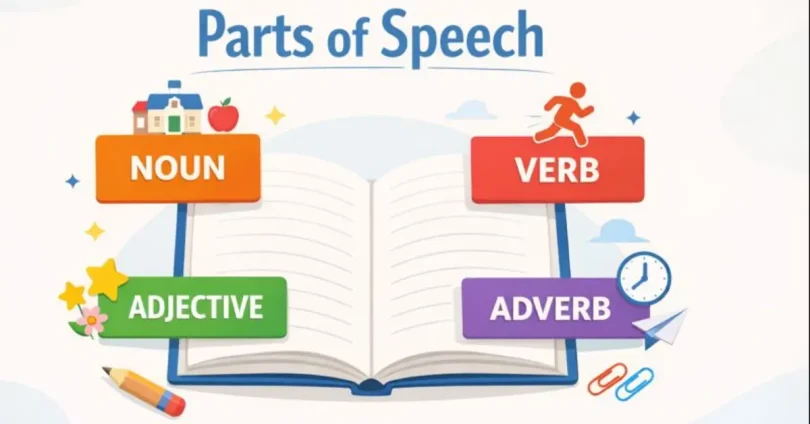
English grammar traditionally recognizes eight main parts of speech.
Nouns: Naming People, Places, and Things
A noun is a word that names a person, place, thing, or idea.
Examples:
- Person: teacher, child
- Place: park, city
- Thing: table, phone
- Idea: honesty, love
Example sentence:
- The teacher explained the lesson.
Pronouns: Replacing Nouns for Clarity
A pronoun replaces a noun to avoid repetition and make sentences smoother.
Common pronouns: I, you, he, she, it, we, they
Example sentence:
- Ali is my friend. He lives nearby.
Verbs: Showing Action or State of Being
A verb shows what the subject does or what state it is in.
Types of verbs:
- Action verbs: run, write, eat
- Linking verbs: is, are, was
Example sentence:
- She writes every day.
Adjectives: Describing Nouns in Detail
An adjective describes or gives more information about a noun.
Examples: big, small, beautiful, interesting
Example sentence:
- It was a beautiful day.
Adverbs: Modifying Verbs, Adjectives, and More
An adverb describes a verb, adjective, or another adverb. It often answers how, when, where, or how much.
Examples: quickly, very, yesterday
Example sentence:
- He spoke clearly.
Prepositions: Showing Relationships Between Words
A preposition shows the relationship between a noun or pronoun and another word in the sentence.
Common prepositions: in, on, under, at, between
Example sentence:
- The keys are on the table.
Conjunctions: Connecting Words and Ideas
A conjunction joins words, phrases, or clauses together.
Common conjunctions: and, but, because, although
Example sentence:
- I wanted to go, but it was raining.
Interjections: Expressing Feelings and Emotions
An interjection expresses emotion or reaction. It often stands alone and may be followed by an exclamation mark.
Examples: Wow! Oh! Oops!
Example sentence:
- Wow! That’s amazing news.
Common Mistakes Learners Make
Many learners confuse:
- Adjectives and adverbs (quick vs quickly)
- Prepositions (in vs on)
- nouns and Pronouns due to unclear references
Practicing with examples helps avoid these mistakes.
How Parts of Speech Improve Writing Skills
When you understand parts of speech, you can:
- Write clearer and more meaningful sentences
- Improve sentence variety
- Edit your own writing confidently
Strong grammar leads to strong communication.
Parts of Speech Chart (Quick Overview)
- Noun – names something
- Pronoun – replaces a noun
- Verb – shows action or being
- Adjective – describes a noun
- Adverb – modifies verbs or adjectives
- Preposition – shows relationships
- Conjunction – connects ideas
- Interjection – expresses emotion
Frequently Asked Questions (FAQs)
What are parts of speech in English grammar?
Parts of speech are categories of words based on their function in a sentence. They help us understand how words work together to form meaningful sentences.
How many parts of speech are there in English?
There are eight main parts of speech in English: noun, pronoun, verb, adjective, adverb, preposition, conjunction, and interjection.
Why are parts of speech important?
Parts of speech help improve sentence structure, grammar accuracy, and clear communication in both writing and speaking.
What is the easiest way to learn parts of speech?
The easiest way is to learn each part with simple definitions, real-life examples, and regular practice through reading and writing.
Are parts of speech important for spoken English?
Yes, understanding parts of speech improves spoken English by helping you choose correct words and form grammatically correct sentences.
Conclusion:
Parts of speech are the backbone of English grammar. By understanding how each type of word functions, you can speak and write with greater confidence and accuracy. Learning them may take time, but with practice, they become second nature.
If you want to improve your English, start with the basics—and parts of speech are the perfect place to begin.