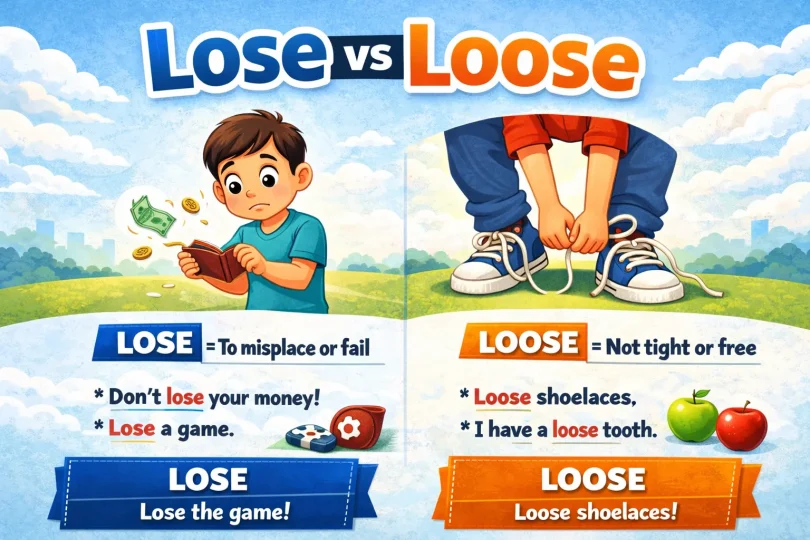

Loose and loose meaning often confuses English learners because both words look almost identical but carry completely different meanings. The keyword lose and loose meaning becomes important when you want to avoid common grammar mistakes in writing and speaking. Many users mix them up in daily communication, which changes sentence meaning completely. To make it simple and clear, let’s break everything down step by step below for better understanding.
What Does Lose Mean?
lose and loose meaning becomes clearer when we first understand “lose.” Lose is a verb and it is used when something is gone, not found, or not won. It describes failure, misplacement, or absence of something. In simple terms, lose always shows something disappearing or not being kept.Before checking examples, understand that lose is very common in daily English. Now look below for better clarity:
- I don’t want to lose my phone.
- Our team might lose the match today.
- You will lose money if you are careless.
- She doesn’t want to lose her job.
Lose (key points):
- Part of speech: Verb
- Pronunciation: looz (rhymes with choose)
- Forms: lost, losing
What Does Loose Mean?
loose and loose meaning becomes easier when we compare it with “loose.” Loose is usually an adjective and it describes something that is not tight, not fixed, or free in movement. It can also describe something relaxed or not controlled.To understand it better, check the examples below carefully:
- This shirt is too loose for me.
- The dog is loose in the yard.
- He likes loose clothing in summer.
- The screw is loose and needs tightening.
Loose (key points):
- Part of speech: Adjective (sometimes verb)
- Pronunciation: loos (rhymes with goose)
- Opposite: Tight
Key Differences Between Lose and Loose
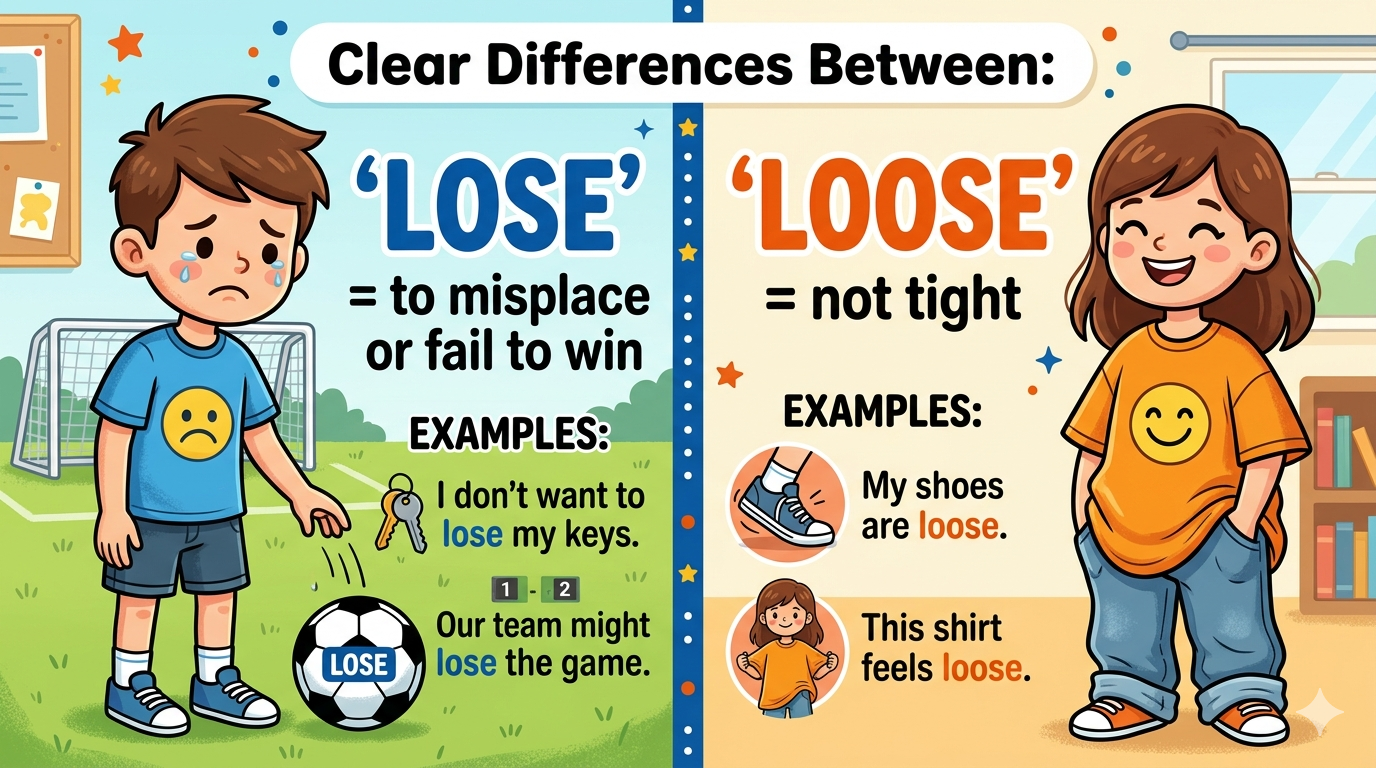
lose and loose meaning becomes very easy when you compare them side by side. Many learners make mistakes because they only focus on spelling instead of meaning and usage.To understand clearly, look at the comparison below:
|
Feature |
Lose |
Loose |
|
Meaning |
To misplace or fail to win |
Not tight or free |
|
Part of Speech |
Verb |
Adjective |
|
Pronunciation |
looz |
loos |
|
Example |
Don’t lose hope |
These clothes are loose |
This comparison shows that lose is about loss or failure, while loose is about something not being tight or fixed.
Common Mistakes People Make
lose and loose meaning often gets confused in writing, especially when typing quickly. Many people accidentally use the wrong spelling, which changes meaning and creates grammar errors.Before checking examples, understand that this is one of the most common English mistakes. Now look below:
❌ I don’t want to loose my keys
✔ I don’t want to lose my keys
❌ My pants will lose after washing
✔ My pants will be loose after washing
The mistake happens because people think both words are interchangeable, but they are not.
Easy Trick to Remember the Difference
lose and loose meaning becomes easier with a simple memory trick. This trick helps you remember the correct spelling and usage quickly during writing or speaking.To make it simple, check the idea below:
- Lose has one “o” → something is gone or lost
- Loose has two “o”s → extra space means not tight
This visual trick helps you avoid confusion and improves your writing accuracy instantly.
Can Loose Be a Verb?
lose and loose meaning also includes a lesser-known fact: loose can sometimes be used as a verb, but it is rare in modern English. Most learners only use loose as an adjective.Before seeing examples, understand that this usage is mostly formal or old-style English. Now check below:
- He decided to loose the arrows.
- The guard loosed the prisoners.
In everyday writing, this usage is not common, but it is still grammatically correct.
Lose vs Loose in Everyday Writing
lose and loose meaning becomes very important in daily communication. Using the wrong word can make your writing look unprofessional or confusing, especially in emails, blogs, academic work, or social media posts.
Before writing anything important, always double-check your sentence. Focus on whether you mean “not winning or losing something” or “not tight or free.”
Final Thoughts
lose and loose meaning is simple once you clearly understand the difference. Lose is used when something is gone, not found, or not won. Loose is used when something is not tight or is free in structure or movement.
Mastering lose and loose meaning improves your English writing accuracy and helps you avoid common mistakes in communication.